One experience that stood out for me in a mental health hospital was that of an autistic child who I would love to give the fictional name, Amina. Amina was a child of 10 years who had lived with autism since she was a year old. Week-in, week-out, she came with her mum to the Hospital to see the doctor, get medications , attend educational therapy and what have you.
So this day, she came in sobbing and I had so much empathy on her that I would have shed a tear. Her mum said to me, “She likes covering her face whenever she steps into a room filled with people but I discouraged her from doing this which led to an outburst of tears”. This scenario is common with children with this disorder because of their poor social skills.
I’m sure you might be curious as to what happened next, how I was able to manage an autistic child who was sobbing, knowing the struggles of children who live with this ailment…
Research on music therapy shows that listening to music engages sub-cortical and cortical areas of the brain. Music has been shown to stimulate the brains’ primary engine of human capacity, exercises attention, evokes emotional response and stimulates the central nervous system. It also appears to activate the human mirror-neuron system, supporting the coupling between perceptual events (visual or auditory) and motor actions (leg, hand, or vocal or articulatory actions).
At one time, theories of human brain development argued that there was little or no growth of brain cells after age 30 but recent studies of music and the brain have shown this view to be erroneous. The brain is a plastic organ and music has the power to shape the brain’s development into later life. The implication of these findings is huge. Providing opportunities for people to experience music in many settings can have a profound impact on their healthy development.
Music has long been recognized as a powerful force in rehabilitative treatment, used clinically to address impairments in motor function, language, cognition, sensory processing, and emotional disturbances that can result from brain injury. It has been used successfully to induce cognitive repair in patients with stroke, Parkinson’s disease, cerebral palsy, or traumatic brain injury. Indeed, music has the potential to “fix” the brain, by providing an alternative entry point into a “broken” brain system to remediate impaired neural processes or neural connections.
Back to my story, I went on to administer music therapy to this young girl. I switched on the music on my phone and she began loosening up, then I picked up my guitar and started singing. Before I could say jack, her eyes were dried and she reached for a pen and began writing. For autistic children, writing is usually a challenge so you can imagine how much my heart leaped with joy when she began writing herself.
You can imagine that her mum tried using non-musical tones to communicate what she wanted her to do and it turned sour but at the sound of music she not only did what she wanted her to do but she did more by writing.
Amina returned home happy and I returned curious about this aspect of Therapy and eager to raise an awareness of it’s potency.
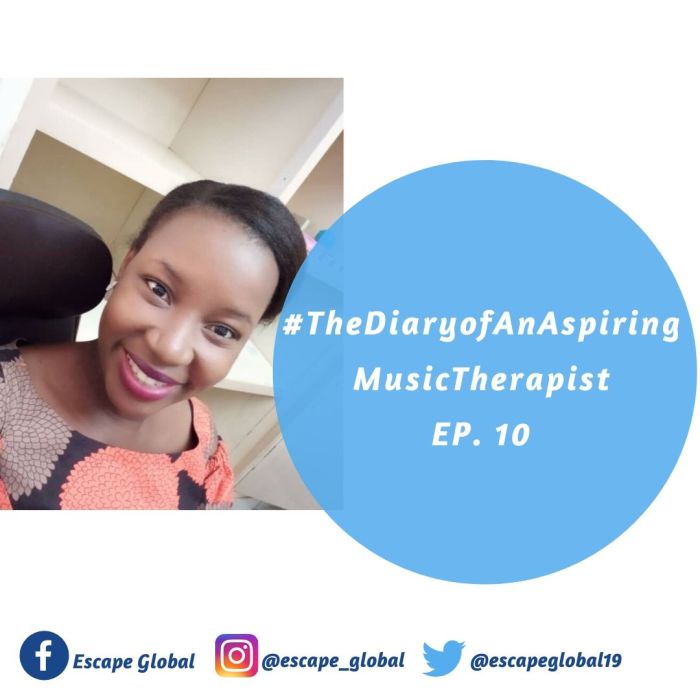
This is #TheDiaryofAnAspiringMusicTherapist, Episode 10
In view of what has been happening in recent weeks across the nations of the earth and the instruction to stay indoors to avoid the spread of the coronavirus, #TheDiaryofAnAspiringMusicTherapist will be on hold. We strongly believe this will end soon.
Please remain obedient to every rule given by our individual government authorities.
I look forward to reading from you and catch you soon!